
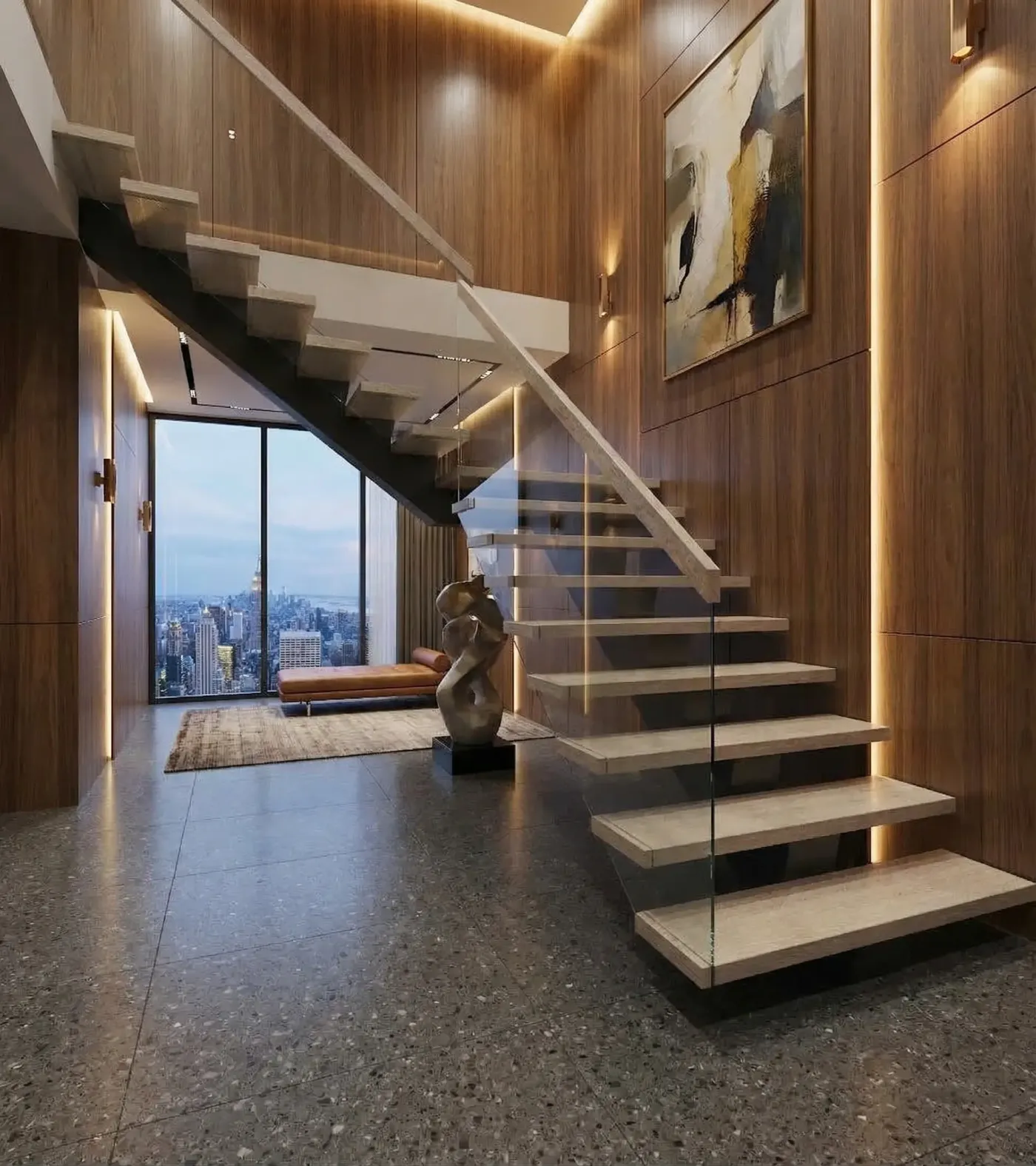
Laser-Cut Steel — The Structure Behind Every Floating Stair We Build
Every system we build uses a laser-cut steel structure fabricated in our shop. No on-site welding. No apparent welds. No adjustments cut in your home. The stair arrives finished and installs in a day.
Every floating stair system built by Toronto Floating Stairs uses a laser-cut steel structure fabricated in our shop. Nothing is cut on-site. Nothing is welded on-site. The structure arrives at your home already finished — powder-coated, inspected, and ready to anchor and align in a single day.
This page explains the steel structure itself: how it's designed, fabricated, and finished before it ever arrives at your door — and why that process produces a cleaner, more precise result than any method that involves site welding or field grinding.
We use laser-cut steel plate stringers as the primary structural element. Laser cutting allows us to cut custom stringer profiles — notched for tread integration, perforated for lightness, or formed with decorative geometry — with tolerances that field fabrication can't match. Precision at this stage is what makes one-day installation possible: when the steel is cut to exact field dimensions, there's nothing to adjust on-site.
The reason there are no apparent welds on the finished structure is that all connections are made in the shop under controlled conditions, then finish-ground and powder-coated before the piece ships. The finish you see on installation day is the factory finish — no touch-up spraying in your home, no exposed weld marks, no rough edges.
Steel stringers for floating stairs in Toronto need to be designed to actual loads and spans, not selected from a product catalogue. We calculate the required plate thickness and anchorage based on the specific stair geometry and OBC loading requirements. This matters more in commercial projects where loading requirements are significantly higher than residential.
Steel stringer configurations
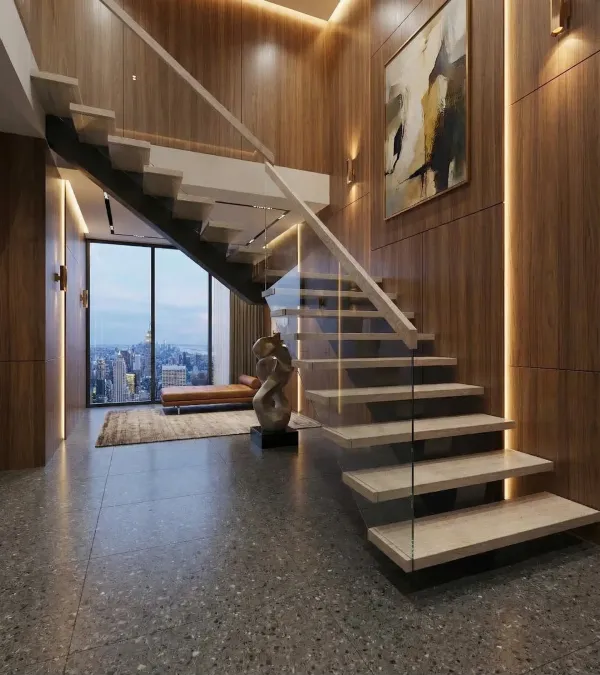
Mono stringer systems use a single centre beam with tread plates welded to each side. Double stringer systems use two parallel beams — one on the wall side, one on the open side — which allows heavier tread spans and a more open visual profile. Open-riser steel systems allow sightlines through the stair entirely, which works well in open-plan lofts.
Design a steel stair for your Toronto space
Project review first. If field verification is required, finish samples, steel profile decisions, and load calculations are coordinated before fabrication begins.
- ✓ Raw mill scale with penetrating oil
- ✓ Powder coat — custom RAL colours
- ✓ Blackened steel with wax seal
- ✓ Clear epoxy over blasted steel
- ✓ Painted primer + topcoat
From Field Measurement to Finished Steel
Laser-Cut Steel Structure — FAQ
Why laser-cut steel for the structure instead of other fabrication methods? +
Can a laser-cut steel floating stair be installed in a residential Toronto home? +
Do powder-coated steel stairs rust? +
What tread materials work with the laser-cut steel structure? +
How much does a laser-cut steel floating stair system cost in Toronto? +
Start Your Floating Stair Project in Toronto
Site assessment. Steel finish samples brought to your space. Proposal within 48 hours.